


Daniel 8:1-27 • Daniel's Vision of a Ram and a Goat

Updated: Jun 24

► Lately, I’ve been reflecting on the importance of correct Bible teaching.
→ One should always endeavor, when teaching Scripture, to make sure they aren’t teaching error.
→ In my own teaching opportunities, I’ve always steered away from areas that I didn’t feel that I could analyze, and then communicate, clearly and with conviction.
→ That is why I’ve always stayed away from teaching prophetic passages, at least those that haven’t been fulfilled yet.
→ But in the Book of Daniel, this can't be helped.
► Today we reach a milestone in our study of the Book of Daniel.
→ We told you all, from the start, that this book is divided into 3 main parts.
1st – chapter 1 is an introduction to us of Daniel, and his 3 friends Shadrack, Meshack, and Abed-nego.
• How they came to Babylon in the 1st of 3 waves of exile from Israel.
• And how they became equipped in a 3 year period of intense training, to serve in King Nebuchadnezzar’s court.
2nd – chapters 2 – 7, where through dreams and visions, the future of the human kingdoms that will rule the earth, and God’s sovereignty over them, are documented.
3rd – chapters 8 – 12, where God’s plan for the future of Israel, and it’s eventual King, who will rule over the entire world.
► The Book of Daniel → The Sovereignty of God over the Kingdoms of Men Hebrew 1 → 1:1-21 Intro and Daniel & Friends Tested and Enter the King's Service Aramaic 2 → 2:1-49 Nebuchadnezzar's First Dream and Promotion of Daniel 3 → 3:1-30 The Image of Gold and the Fiery Furnace 4 → 4:1-37 Nebuchadnezzar Dreams. Goes Insane, and Comes to His Senses 5 → 5:1-30 The Handwriting on the Wall 6 → 6:1-28 Daniel in the Lion's Den 7 → 7:1-28 Daniel's Dream and Visions of Four Beasts Hebrew 8 → 8:1-27 Daniel's Vision of a Ram and a Goat 9 → 9:1-27 Daniel's Prayer and Seventy Sevens 10 → 10:1 – 11:1 Daniel's Mourning and Terrifying Vision 11 → 11:2-35 The Kings of the South and the North 12 → 11:36 – 12:13 The King Who Exalts Himself and the End Times |
→ The 1st and 3rd sections written in Hebrew, and the 2nd section written in Aramaic, the language of the Chaldeans.
► And today we begin that 3rd section.
Review • Chronological
► I want you to remember also, that the book of Daniel is not presented to us in a chronological order, but rather is topical.
→ Here we’ll see the chronological order, at least my attempts at making it so.
Nebuchadnezzar
Chapter | Verses | Dates (approx) | Notes |
1 → | 1:1-21 | 605-602BC… | Daniel, we assume, was 15 yrs old when exiled, and 18 yrs old when he started serving Neb |
2 → | 2:1-49 | 602-601BC… | Daniel was 18 or 19 yrs old Dan 2:1 “Now in the second year of the reign of Nebuchadnezzar,…” |
3 → | 3:1-30 | Guesses… 595-585BC… | Daniel would have been anywhere from 25 to 35 yrs old |
4 → | 4:1-37 | Guesses… 571-562BC… | Daniel would have been somewhere between 49 to 58 yrs old |
Belshazzar
Chapter | Verses | Dates (approx) | Notes |
7 → | 7:1-28 | 553BC… | Daniel was 67 yrs old Dan 7:1 “In the first year of Belshazzar king of Babylon…” NOTE: While Belshazzar’s father, Nabonidus, took the throne in 556BC, it is believed that Belshazzar didn’t take control until 553BC, when Nabonidus left for an extended trip of conquest. |
8 → | 8:1-27 | 551-550BC… | Daniel was 69-70 yrs old Dan 8:1 “In the third year of the reign of Belshazzar the king…” |
5 → | 5:1-30 | 539BC… | Daniel was 81 yrs old We know from history that Belshazzar was killed in 539BC |
Darius
► I will mention here that last time I taught, on chapter 3, I presented a list with chapter 10 at the end.
→ The reason I did that is because after a very cursory reading of the latter chapters, I saw in the beginning of chapter 11 the phrase “In the first year of Darius the Mede".
→ I made the assumption, without fully investigating the context of the passage that chapter 11 belonged with chapters 6 and 9, and since chapter 12 seems to flow with that, I left only chapter 10 to speak in regard to the time of Cyrus.
→ I now realize that similar to chapter 12 being an extension of chapter 11, chapter 11 is also an extension of chapter 10.
→ I’ve also moved chapter 6 to be after chapter 9. We really don’t know whether if happened before or after chapter 9, but in deference to my associate Jay (co-teacher in my SS class), I will defer to his outline, and place chapter 6 after 9.
Chapter | Verses | Dates (approx) | Notes |
9 → | 9:1-27 | 539BC… | All of Darius’s exploits had to have happened in 539, as we know that Cyrus also took control in this year Dan 9:1 “In the first year of Darius…” |
6 → | 6:1-28 | 539BC… | Daniel was 81 yrs old NOTE: No exact date is given for this passage, but it had to be in 539, if Darius is anyone other than Cyrus. |
Cyrus
Chapter | Verses | Dates (approx) | Notes |
10 → | 10:1 – 11:1 | 537-536BC… | Daniel was 83-84 yrs old Dan 10:1 “In the third year of Cyrus king of Persia…” |
11 → | 11:2-35 | Continuation of chapter 10 | |
12 → | 11:36 – 12:13 | Continuation of chapter 11 |
► I’m going to interject here that there will be a lot of similarities in chapter 8 to what we saw in chapter 7, at least in the language used to describe some of the events.
► But I want to forewarn you that, in contrast to chapter 7, which looked at prophetic fulfillments at the end of time, chapter 8’s prophecies will actually be fulfilled before the time of Christ, but with implications of being a shadow of what is to come in the end times.
► Some of what we look at today will be viewed even more deeply and specifically in chapter 11.
► Daniel 8 outline
→ Daniel 8:1 → The historical setting
→ Daniel 8:2-14 → The vision
→ Daniel 8:15-26 → The vision explained
→ Daniel 8:27 → Daniel’s response to the vision
Daniel 8:1 → The historical setting
1 In the third year of the reign of Belshazzar the king a vision appeared to me, Daniel, subsequent to the one which appeared to me previously.
the third year of the reign of Belshazzar
► NOTE: While Belshazzar’s father, Nabonidus, took the throne in 556BC, it is believed that Belshazzar didn’t take control until 553BC, when Nabonidus left for an extended trip of conquest.
► That would make the current year about 551-550BC… Daniel was 69-70 yrs old
a vision appeared to me, Daniel, subsequent to the one which appeared to me previously
► He is speaking in reference to the vision he had 2 years prior, which we looked at in chapter 7
► I’d like to talk for a minute about all these visions and dreams.
→ They ALL have to do with the same 4 kingdoms – Babylon, Medo-Persia, Greece, and Rome.
→ Yet each reference to them has an unique focus.
Daniel 8:2 - 14 → The vision
2 I looked in the vision, and while I was looking I was in the citadel of Susa, which is in the province of Elam; and I looked in the vision and I myself was beside the Ulai Canal.
citadel of Susa, which is in the province of Elam; and I looked in the vision and I myself was beside the Ulai Canal.
► While in Babylon, Daniel is transported in his vision to the future capitol of the Persian empire.
→ We understand from the book of Esther, which occurs in the post-exile time frame of 483-473BC, that this is where the King of Persia resides.
► Susa is about 250 miles east of Babylon.
3 Then I lifted my eyes and looked, and behold, a ram which had two horns was standing in front of the canal. Now the two horns were long, but one was longer than the other, with the longer one coming up last. 4 I saw the ram butting westward, northward, and southward, and no other beasts could stand before him nor was there anyone to rescue from his power, but he did as he pleased and magnified himself.
► I’m not going to explain any of this descriptive language from verses 3 to 14 until we get to the “vision explained” part of our text, but we will come back to these points.
→ a ram which had two horns
→ the two horns were long, but one was longer than the other, with the longer one coming up last.
→ I saw the ram butting westward, northward, and southward, and no other beasts could stand before him nor was there anyone to rescue from his power, but he did as he pleased and magnified himself.
5 While I was observing, behold, a male goat was coming from the west over the surface of the whole earth without touching the ground; and the goat had a conspicuous horn between his eyes. 6 He came up to the ram that had the two horns, which I had seen standing in front of the canal, and rushed at him in his mighty wrath. 7 I saw him come beside the ram, and he was enraged at him; and he struck the ram and shattered his two horns, and the ram had no strength to withstand him. So he hurled him to the ground and trampled on him, and there was none to rescue the ram from his power. 8 Then the male goat magnified himself exceedingly. But as soon as he was mighty, the large horn was broken; and in its place there came up four conspicuous horns toward the four winds of heaven.
→ A male goat was coming from the west.. with a single horn between his eyes.
→ The goat fights with the ram and utterly crushes him.
→ Then the male goat exalts himself, and then dies, and his kingdom is taken over by 4 of his subordinates.
9 Out of one of them came forth a rather small horn which grew exceedingly great toward the south, toward the east, and toward the Beautiful Land. 10 It grew up to the host of heaven and caused some of the host and some of the stars to fall to the earth, and it trampled them down. 11 It even magnified itself to be equal with the Commander of the host; and it removed the regular sacrifice from Him, and the place of His sanctuary was thrown down. 12 And on account of transgression the host will be given over to the horn along with the regular sacrifice; and it will fling truth to the ground and perform its will and prosper. 13 Then I heard a holy one speaking, and another holy one said to that particular one who was speaking, “How long will the vision about the regular sacrifice apply, while the transgression causes horror, so as to allow both the holy place and the host to be trampled?” 14 He said to me, “For 2,300 evenings and mornings; then the holy place will be properly restored.”
→ This comes out of Greece and will be discussed in the “vision explained” section.
Daniel 8:15 - 26 → The vision explained
15 When I, Daniel, had seen the vision, I sought to understand it; and behold, standing before me was one who looked like a man.
► So Daniel has seen the prophetic vision, and he “had seen” someone who looks “like a man”.
16 And I heard the voice of a man between the banks of Ulai, and he called out and said, “Gabriel, give this man an understanding of the vision.”
► Then he’s hearing a voice, talking to the “man”, addressing him as “Gabriel”, and giving him instruction to fill in the blanks for Daniel.
→ “Gabriel” – this is the first time in the entire Bible that the name of an angel is given.
→ Gabriel is also mentioned in Daniel 9:21 and in Luke 1:19, where he visits with Zechariah, then in Luke 1:26, where he spends time with Mary, the mother of Jesus.
→ The only other angel, other than Satan, who is named in the Bible is Michael, and he is mentioned twice in chapter 10 (Dan 10:13,21) and once in chapter 12 (Dan 12:1). Michael is also mentioned in Jude 9 and Rev 12:7, in the New Testament.
17 So he came near to where I was standing, and when he came I was frightened and fell on my face; but he said to me, “Son of man, understand that the vision pertains to the time of the end.”
► Gabriel comes close, creating a little fear in Daniel, fear that prompted Daniel to lie flat (or did he pass out?).
→ Gabriel addresses Daniel as “son of man”, but unlike the Aramaic references used in chapter 7 to characterize the future Christ, the choice of a different Hebrew word here just emphasizes Daniel’s own humanity and mortality.
18 Now while he was talking with me, I sank into a deep sleep with my face to the ground; but he touched me and made me stand upright.
► Daniel “sank into a deep sleep”, but I wonder if he just passed out again.
→ Remember that Daniel is now about 70 years old – my age – and maybe this is just a little too much for him.
→ Gabriel touches Daniel and made him stand up.
19 He said, “Behold, I am going to let you know what will occur at the final period of the indignation, for it pertains to the appointed time of the end.
► In the last verse of this section, Gabriel tells Daniel that he is “going to let you know what will occur at the final period of the indignation, for it pertains to the appointed time of the end.”
→ Now a special note needs to be made here in regards to “the final period of the indignation”, and the “appointed time of the end”.
→ While these words, especially in light of chapter 7, would normally lead one to think he’s referring to the end of time, they actually are referring to a different time period.
→ All the previous passages that deal with future events, give a plan that takes us to the end.
• Babylon, Medo-Persia, Rome, and beyond.
• Please notice that this passage only deals with Medo-Persia and Greece.
• Chapter 11 will also only deal with Medo-Persia and Greece.
→ The context for our “period of indignation” and “time of the end” in this chapter, are confined to the end of the reign of Greece. Rome is yet to come.
► So in a nutshell, Gabriel is talking to Daniel about a time period that runs into the inter-testamental period, but not beyond.
► I’ll attempt to make this more clear as we move on.
The Ram's Identity
► So now we get to the point where we are going to look at the specifics of the 2 creatures we saw.
••• Compared with •••
Daniel 8:3-4 →
3 I Then I lifted my eyes and looked, and behold, a ram which had two horns was standing in front of the canal. Now the two horns were long, but one was longer than the other, with the longer one coming up last. 4 I saw the ram butting westward, northward, and southward, and no other beasts could stand before him nor was there anyone to rescue from his power, but he did as he pleased and magnified himself.
► 3 …a ram which had two horns…
→ So we clearly see that this ram represents Medo-Persia – the text plainly tells us so.
→ The two horns represent the two combined nations.
► 3 …the two horns were long, but one was longer than the other, with the longer one coming up last.
→ The one horn being longer than the other would represent the disparity between the two nations.
→ We understand historically that Persia was, and is, much more powerful than it’s conjoined twin, Media.
→ The land of Persia still exists today. Now it’s called Iran.
► 4 I saw the ram butting westward, northward, and southward, and no other beasts could stand before him nor was there anyone to rescue from his power, but he did as he pleased and magnified himself.
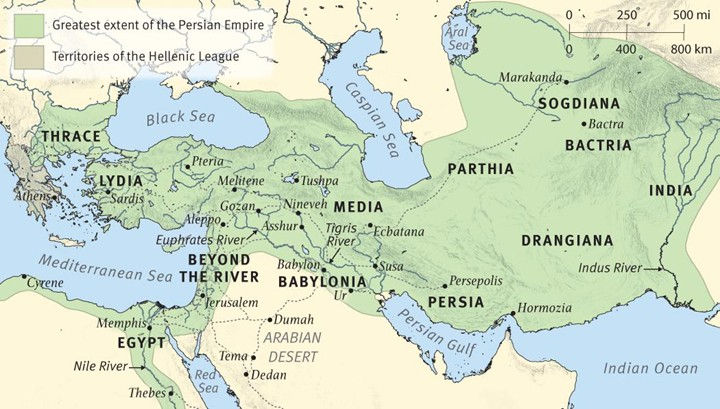
→ This portion clearly explains the significance of their drive to acquire additional area to expand the reach of their domain.
→ At that time, they were the most powerful nation in the world. For a time.
→ Review the map below to see the expansion of the kingdom.
The Goat
21 “The shaggy goat represents the kingdom of Greece, and the large horn that is between his eyes is the first king. 22 The broken horn and the four horns that arose in its place represent four kingdoms which will arise from his nation, although not with his power.
••• Compared with •••
Daniel 8:5-8 →
5 While I was observing, behold, a male goat was coming from the west over the surface of the whole earth without touching the ground; and the goat had a conspicuous horn between his eyes. 6 He came up to the ram that had the two horns, which I had seen standing in front of the canal, and rushed at him in his mighty wrath. 7 I saw him come beside the ram, and he was enraged at him; and he struck the ram and shattered his two horns, and the ram had no strength to withstand him. So he hurled him to the ground and trampled on him, and there was none to rescue the ram from his power. 8 Then the male goat magnified himself exceedingly. But as soon as he was mighty, the large horn was broken; and in its place there came up four conspicuous horns toward the four winds of heaven.
► 5 …a male goat was coming from the west over the surface of the whole earth without touching the ground; and the goat had a conspicuous horn between his eyes.
→ The text in verse 21 tells us that this goat is "the kingdom of Greece".
→ It also tells us that the single, "large horn", is it’s first king – this would be Alexander the Great.
→ When it talks about the goat not “touching the ground” I’m guessing he’s giving the impression that it’s flying. Alexander conquered so fast it was almost like he was flying.
► 6 He came up to the ram that had the two horns, which I had seen standing in front of the canal, and rushed at him in his mighty wrath. 7 I saw him come beside the ram, and he was enraged at him; and he struck the ram and shattered his two horns, and the ram had no strength to withstand him. So he hurled him to the ground and trampled on him, and there was none to rescue the ram from his power.
→ This talks about how Alexander defeated the kingdom of the Medo-Persian so quickly and violently.
► 8 Then the male goat magnified himself exceedingly. But as soon as he was mighty, the large horn was broken; and in its place there came up four conspicuous horns toward the four winds of heaven.
→ Alexander was puffed up with pride, yet he was killed before he could leave an heir.
→ His kingdom was then divided between 4 of his generals…
1) Cassander → Macedonia
2) Lysimachus → Thrace and Asia Minor
3) Seleucus → Syria and Babylonia
4) Ptolemy → Egypt and Arabia
The "other" Little Horn
••• Compared with •••
Daniel 8:9-14 →
9 Out of one of them came forth a rather small horn which grew exceedingly great toward the south, toward the east, and toward the Beautiful Land. 10 It grew up to the host of heaven and caused some of the host and some of the stars to fall to the earth, and it trampled them down.
11 It even magnified itself to be equal with the Commander of the host; and it removed the regular sacrifice from Him, and the place of His sanctuary was thrown down. 12 And on account of transgression the host will be given over to the horn along with the regular sacrifice; and it will fling truth to the ground and perform its will and prosper. 13 Then I heard a holy one speaking, and another holy one said to that particular one who was speaking, “How long will the vision about the regular sacrifice apply, while the transgression causes horror, so as to allow both the holy place and the host to be trampled?” 14 He said to me, “For 2,300 evenings and mornings; then the holy place will be properly restored.”
► 9 …a rather small horn which grew exceedingly great toward the south, toward the east, and toward the Beautiful Land.
→ In contrast to the “little horn” from Daniel 7:8, which appears to come out of the future 10 nations of a revitalized Rome, this “small horn” is actually a product of Greece, most specifically from the kingdom of Seleucus, and his name is Antiochus IV Epiphanes.
→ “the Beautiful Land” believed to be a reference to Israel.
→ He will capture Palestine from Ptolemy, and rule from 175-164BC.
→ He represents the “near” fulfillment of these prophecies, which are more fully explored in Daniel 11:2-35.
→ The antichrist, who will come at the end of time, is the “far” fulfillment, documented in Daniel 11:36-45.
► 10 It grew up to the host of heaven and caused some of the host and some of the stars to fall to the earth, and it trampled them down.
→ At least one commentator mentioned that this was a reference to the persecution of Jews in Israel.
► 11 It even magnified itself to be equal with the Commander of the host; and it removed the regular sacrifice from Him, and the place of His sanctuary was thrown down. 12 And on account of transgression the host will be given over to the horn along with the regular sacrifice; and it will fling truth to the ground and perform its will and prosper.
→ His blatant attempt to kill off Jewish worship and tradition and observance to the Scriptures, were merely an attempt to move the worship of the Creator onto himself.
► 13 Then I heard a holy one speaking, and another holy one said to that particular one who was speaking, “How long will the vision about the regular sacrifice apply, while the transgression causes horror, so as to allow both the holy place and the host to be trampled?” 14 He said to me, “For 2,300 evenings and mornings; then the holy place will be properly restored.”
→ The 2,300 days, or 6.3 years coincides with the assassination of the high priest Onias III in 170BC and continued until the death of Antiochus, by disease, in 164BC.
→ The phrase "evenings and mornings" is used to make us realize that in this case he is referring to literal 24 hour days.
Daniel 8:27 → Daniel’s response
27 Then I, Daniel, was exhausted and sick for days. Then I got up again and carried on the king’s business; but I was astounded at the vision, and there was none to explain it.
► I think you can just imagine, Daniel, with no commentaries or Bible Encyclopedias to turn to, is a little amazed at what he’s seeing.
► Keep in mind, this is nothing new for him – he’s heard some of this information before…
→ Chapter 2 – Nebuchadnezzar’s dream of the multi-material statue representing Babylon, Medo-Persia, Greece, and Rome, with a final divine kingdom.
→ Chapter 7 – Daniel has a dream of 4 different beasts, each of which representing the same 4 countries, and the same divine ending.
→ Now in chapter 8 – Daniel’s vision of the two beasts, representing Medo-Persia and Greece, Babylon not represented as it won’t be around much longer in it’s existing state.
• And the ending being spoken of in this chapter is more about the end of the Grecian impact on the nation, which will be before Jesus comes the first time, rather than the eventual end when Jesus comes back again.
► So why wouldn’t he be a little worn out with all this “doom and gloom” information in regards to the future of the world, and specifically as he worries about Israel’s place in all of it.
► And even when it says “there was none to explain it”, he did in fact have someone giving him some of the details, but it’s still a mystery as to how all of this is going to come about.
► So it’s no wonder he was “exhausted and sick for days”.
► But at the end of it, he really had no other option than to get back to the business of his daily life.
So What?
► In trying to come up with some application as to what do you do now, I come back to the verse I shared with you last time I taught. There will be times in the future that are going to become pretty ugly. But we should take courage. Because as we attempt to make sure we are walking in a manner pleasing to the Lord, He will be with us at all times.
Joshua 1:8-9 → 8 This book of the law shall not depart from your mouth, but you shall meditate on it day and night, so that you may be careful to do according to all that is written in it; for then you will make your way prosperous, and then you will have success. 9 Have I not commanded you? Be strong and courageous! Do not tremble or be dismayed, for the Lord your God is with you wherever you go.”
► Let me finish by sharing the same ideas that one of my fellow teachers did when he taught on chapter 7…
→ God is absolutely sovereign over the kingdoms of men.
→ Their evil rule is limited by God and will come to an end.
→ God will establish His eternal kingdom on earth that will never be destroyed.
→ Those who have placed their faith in Jesus will reign with Him in His eternal kingdom.
→ Until then, we are called to join Christ in seeking those who are lost and sharing with them the eternal hope that we have in Jesus.
Posts in this series
► Daniel 8:1-27 • Daniel's Vision of a Ram and a Goat
Photo • 2022/06/04 - Overlooking Owens Dry Lake, from the road to Cottonwood Lakes Trailhead, Lone Pine, CA
“Scripture quotations taken from the (NASB®) New American Standard Bible®, Copyright © 1960, 1971, 1977, 1995
by The Lockman Foundation. Used by permission. All rights reserved. lockman.org”
All linked verses are from the YouVersion at www.Bible.com



Comments