


Daniel 7:1-28 • Daniel's Dream and Visions of Four Beasts

Updated: Jun 24

► I mentioned in a previous post that the Book of Daniel is basically divided into 3 topic based sections, rather than being laid out in a chronological fashion.
► This can seem somewhat confusing to those of us in modern times, as we are taught from our earliest educational experiences to understand history in a progressive, chronological order.
► But the Book of Daniel, while dealing with historical events, groups them by subject, rather than time.
► In a nutshell, there are 3 main groups...
→ Chapter 1 - This is the Personal History of Daniel, where we find out how Daniel, a young man who was a member of the upper echelon of Jewish society in Jerusalem, ended up in Babylon, being trained to work in the government of that country.
→ Chapters 2 - 7 are focused on the Gentile Nations of the World, those being the current state of Babylon, currently being run by the Chaldeans, but soon to be replaced by the Medo-Persians, then the Greeks, and eventually the Romans.
→ Chapters 8 - 12 focus mainly on the future of the Nation of Israel. And not so much on the immediate future, but the future of Israel as it pertains to the events of the end times.
► Today we will be looking at chapter 7, within the section where Daniel has recorded events where God is revealing information about the future of the Gentile nations of the world.
► This middle section (chapters 2 - 7) has a unique feature to it, in that it is presented in a chiastic format.
→ Basically what this means is that the 1st and last parts compliment each other.
→ The 2nd and second-to-last also compliment each other.
→ The middle section (or sections as in the case of the Book of Daniel) make up the main focus of the entire chiasm.
→ This is how the chiasm looks in Daniel...
Chapter Verses Subject
2 → 2:1-49 A – Succession of Gentile Powers
3 → 3:1-30 B – Deliverance From The Furnace
4 → 4:1-37 C – Humbled For Pride
5 → 5:1-30 C’ – Humbled For Arrogant Defiance
6 → 6:1-28 B’ – Deliverance From The Den of Lions
7 → 7:1-28 A’ – Succession of Gentile Powers
► So we see how chapters 2 and 7 both deal with the succession of Gentile powers, where God reveals information about multiple layers of world domination.
► Today we'll be looking at chapter 7, which is both the last section focused primarily on the Gentile Nations of the World (not that there isn't some reference to the One who will come after), but is also the parallel thought of chapter 2, to finish out the chiastic layout of chapters 2 through 7.
Vision of the Four Beasts
1 In the first year of Belshazzar king of Babylon Daniel saw a dream and visions in his mind as he lay on his bed; then he wrote the dream down and related the following summary of it.
→ This passage, while parallel in thought to chapter 2, is a little bit different in that instead of the king (Belshazzar mentioned in this section; Nebuchadnezzar was the king in chapter 2) having the dream, this time the dream belongs entirely to Daniel.
→ Belshazzar even being mentioned here really only gives us an idea of when this event may have occurred.
→ Commentators have a few differing views on exactly when this "first year" actually takes place, some referencing as early as 553BC, and at least one specifying as late as 550BC.
→ This even would have happened roughly about 14 years or so before the events in chapter 5, where Belshazzar's death is recorded, and would make Daniel about 67 years old. He was about 18 when the events in chapter 2 played out.
→ We do know historically that Belshazzar's death, and the change of the kingdom from Chaldean rule (Babylonian Dynasty X), to Medo-Persian rule (Babylonian Dynasty XI), occurred in 539BC.
2 Daniel said, “I was looking in my vision by night, and behold, the four winds of heaven were stirring up the great sea. 3 And four great beasts were coming up from the sea, different from one another.
→ 1st, there are 4 winds, stirring up the sea/ocean, each wind bringing up out of the water a "great beast", all unique from each other.
→ Being a parallel passage to chapter 2, one would expect that the 4 winds and the 4 beasts, would be representative of Babylon, Medo-Persia, Greece, and Rome.

4 The first was like a lion and had the wings of an eagle. I kept looking until its wings were plucked, and it was lifted up from the ground and made to stand on two feet like a man; a human mind also was given to it.
→ Beast 1 - a "lion" with "the wings of an eagle".
• Wings are "plucked".
• Forced to stand "like a man".
• Given a "human mind".
→ Commentators are pretty much in agreement, that just like the golden head of the statue in chapter 2, the lion with wings represents the current state of the Chaldean leadership of Babylon.
→ Several Biblical references in Jeremiah (and a few other Biblical authors) describe Nebuchadnezzar in terms of being a lion and/or an eagle.

5 And behold, another beast, a second one, resembling a bear. And it was raised up on one side, and three ribs were in its mouth between its teeth; and thus they said to it, ‘Arise, devour much meat!’
→ Beast 2 - a "bear" which was "raised up on one side" (whatever that means).
• 3 "ribs" which were "between its teeth".
• "They" (who are "they"?) said to "devour much meat".
→ This would represent the takeover of Babylon by the Medo-Persians, which actually came in 539BC.
→ Again, commentators mention that the uneven appearance, of being raised up on one side, is to indicate that the Persian side of this image is the predominant one.
→ And the 3 ribs represent the 3 nations conquered by them (Babylon, 539BC; Lydia, 546BC; and Egypt, 525BC).
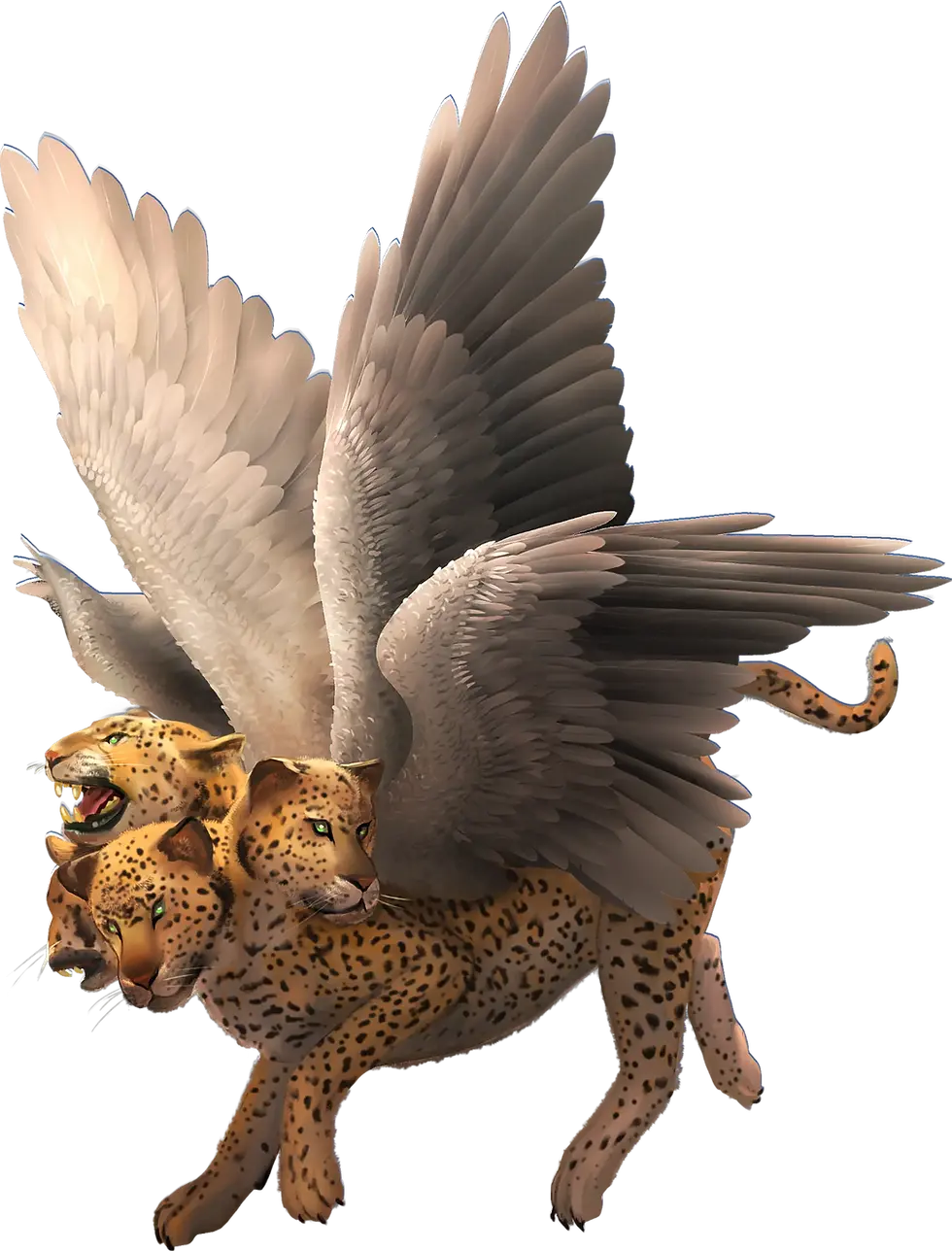
6 After this I kept looking, and behold, another one, like a leopard, which had on its back four wings of a bird; the beast also had four heads, and dominion was given to it.
→ Beast 3 - a "leopard" having "four wings of a bird" on its back.
• I'm assuming that's two pair of wings.
• It has "four heads".
• It was given "dominion".
→ This would represent the nation of Greece, as Babylon would be conquered by Alexander the Great.
→ When he died in 323BC, his kingdom was divided between 4 of his generals.

7 After this I kept looking in the night visions, and behold, a fourth beast, dreadful and terrifying and extremely strong; and it had large iron teeth. It devoured and crushed and trampled down the remainder with its feet; and it was different from all the beasts that were before it, and it had ten horns. 8 While I was contemplating the horns, behold, another horn, a little one, came up among them, and three of the first horns were pulled out by the roots before it; and behold, this horn possessed eyes like the eyes of a man and a mouth uttering great boasts.
→ Beast 4 - We are not told what this looks like other than it is "dreadful and terrifying and extremely strong", with "large iron teeth".
• We are left to our own imagination to come up with an image for this horrid beast.
• It mentions 10 horns, which would correspond to the 10 toes in chapter 2.
• And there is mention of an additional horn popping up, a smaller one that actually pulls out 3 of the previous 10 horns.
• This last horn has human eyes and a human mouth.
→ While the commentators are pretty much in agreement, that this beast is Rome, there is some disagreement about the 10 horns and the additional "little" horn.
• Some seem to believe that the 10 are either Roman kings, or a set of Roman controlled sub-states.
• Some also seem to think that the 1 little horn is Antiochus Epiphanes, the Grecian ruler who would desecrate the temple during the intertestamental period, documented in the apocryphal books of 1st and 2nd Maccabees.
• But the over-riding thought is that, while the beast itself is the historical Rome, and corresponds to the iron legs in the statue in chapter 2, the 10 horns will actually be a future re-imagining of Rome, and the little horn will actually be the Antichrist who will appear and mislead many.
The Ancient of Days Reigns
→ The "Ancient of Days", referring to God Himself, sitting on His judgement seat.
11 “Then I kept looking because of the sound of the boastful words which the horn was speaking; I kept looking until the beast was slain, and its body was destroyed and given to the burning fire. 12 As for the rest of the beasts, their dominion was taken away, but an extension of life was granted to them for an appointed period of time.
→ So Rome is to be destroyed, along with it's front-man, the Anti-Christ, but the other three entities (Babylon, Medo-Persia, and Greece) are given a temporary reprieve.
The Son of Man Presented
→ We've already established that the "Ancient of Days" is God the Father.
→ Now we are introduced to the "Son of Man", whom we know to be Jesus, the Son of God, the 2nd person of the Trinity.
→ And to Jesus is given "dominion, glory and a kingdom,...", in essence that He is being put in charge officially, of everything.
→ Everything and everyone will be in submission to Him.
→ And His rule is eternal.
The Vision Interpreted
15 “As for me, Daniel, my spirit was distressed within me, and the visions in my mind kept alarming me. 16 I approached one of those who were standing by and began asking him the exact meaning of all this. So he told me and made known to me the interpretation of these things:
→ One of the things I find odd about this particular event, is that Daniel, the interpreter of visions and dreams, can't understand his own dream.
→ He has to ask someone else (Shadrack, Meshach, Abed-nego???) to interpret this dream for him.
17 ‘These great beasts, which are four in number, are four kings who will arise from the earth. 18 But the saints of the Highest One will receive the kingdom and possess the kingdom forever, for all ages to come.’
→ Daniel is told about the 4 kingdoms (which we believe to be Babylon, Medo-Persia, Greece, and Rome).
→ But he is also told that eventually the "Highest One" will come to rule with all of His "saints", and that this kingdom will last forever.
19 “Then I desired to know the exact meaning of the fourth beast, which was different from all the others, exceedingly dreadful, with its teeth of iron and its claws of bronze, and which devoured, crushed and trampled down the remainder with its feet, 20 and the meaning of the ten horns that were on its head and the other horn which came up, and before which three of them fell, namely, that horn which had eyes and a mouth uttering great boasts and which was larger in appearance than its associates. 21 I kept looking, and that horn was waging war with the saints and overpowering them 22 until the Ancient of Days came and judgment was passed in favor of the saints of the Highest One, and the time arrived when the saints took possession of the kingdom.
→ Daniel, still confused about his vision, wants more specifics about this 4th beast, it's 10 initial horns, and the "extra" horn.
23 “Thus he said: ‘The fourth beast will be a fourth kingdom on the earth, which will be different from all the other kingdoms and will devour the whole earth and tread it down and crush it.
→ Again, this 4th beast we believe to be Rome in it's original, historical, entity.
→ Commentators mostly agree that this is some future "kingdom" with 10 kings all reigning at the same time.
→ Probably some kind of consortium of nations, like the EU, having some localized rule, but also configured as a single entity in some regards.
and another will arise after them, and he will be different from the previous ones and will subdue three kings. 25 He will speak out against the Most High and wear down the saints of the Highest One, and he will intend to make alterations in times and in law; and they will be given into his hand for a time, times, and half a time.
→ The most consistent thought among commentators, is that this "another" king is the antichrist.
→ Rising to power by subduing 3 of the 10 kings, and basically taking control of the others.
→ His process will be that he...
1 • will "speak out against the Most High", in essence, he will blaspheme God. How specifically remains to be seen, but he will test the authority of God.
2 • will "wear down the saints of the Highest One", representing negative actions against the Jews.
3 • will "intend to make alterations in times and in law", revealing that he will change, or at least attempt to change, the religious structure, and the truth, in order to create one of his own.
→ The reference to "a time, times, and half a time" is generally thought to be a reference to the 3-1/2 year period of the second half of the tribulation period.
26 But the court will sit for judgment, and his dominion will be taken away, annihilated and destroyed forever. 27 Then the sovereignty, the dominion and the greatness of all the kingdoms under the whole heaven will be given to the people of the saints of the Highest One; His kingdom will be an everlasting kingdom, and all the dominions will serve and obey Him.’
→ This prophetic revelation goes on to state that this 11th horn, the one we assume to be the antichrist, will be judged, then destroyed.
→ The end result of all of this is that the kingdom at that point will still be an earthly kingdom, and will be placed in charge of the remaining believing Jews, under the supervision of the Lord Jesus Christ.
28 “At this point the revelation ended. As for me, Daniel, my thoughts were greatly alarming me and my face grew pale, but I kept the matter to myself.”
→ At this point in the story, Daniel is distressed, and kept the visions to himself.
→ But obviously, at the time of the writing of his memoirs, he decided to include this information.
So What?
► It's somewhat amazing to see that, in contrast to chapter 2, where he not only was given revelation of the meaning of Nebuchadnezzar's dream, but was also given the dream itself, that Daniel was fully capable to reveal that information to the king, but now, about 49 years or so later, that when dealing with similar information, Daniel is struggling to understand what is being revealed to him.
► Perhaps it's because unlike chapter 2, this revelation goes on to include the extra horn, the one who radically upsets the entire course of history so dramatically.
► Either way, this passage does little in the way of giving us applicable instruction in how to live out our faith. Other than giving us the reminder, that no matter how bad it gets in our world, that our God is still in control, and is orchestrating events toward His desired end of saving mankind from our sin, and preparing to bring us into a glorified state.
► We should all be looking forward to that time, with hope for our future with Him, which was provided for us by Jesus, when he died in our place on the cross.
Posts in this series
► Daniel 7:1-28 • Daniel's Dream and Visions of Four Beasts
Photo • 2022/06/03 - Trail of the 100 Giants, north of Kernville, CA
“Scripture quotations taken from the (NASB®) New American Standard Bible®, Copyright © 1960, 1971, 1977, 1995
by The Lockman Foundation. Used by permission. All rights reserved. lockman.org”
All linked verses are from the YouVersion at www.Bible.com


Comments