


Genesis Genealogies • The line of Christ • From Adam to Jesus


► In my previous post I mentioned that I might do an entire post just on the genealogical records in the book of Genesis, and this is it.
► I'm not going to look at all the genealogies, but only those that follow the line of Christ.
► And to be specific, within the framework of Genesis, that means we'll be tracking primarily the records from Adam to Judah.
► Keep in mind that for Judah, there are no records that can give us a logical timeframe for his birth and/or death, BUT for his brother Joseph, who is NOT in the line of Christ, we do have those records, so we'll finish the Genesis section of this presentation including Joseph so we can end Genesis with some fairly accurate dates to cover the entire book.
► So we also won't be looking at the family trees of Ishmael, the 1st biological son of Abraham (Gen 25:12-18), or of Esau, Jacob's brother and grandson of Abraham (Gen 36:9-43).
► I will be showing some info that is post-Genesis, but only for reference sake.
► Follow this link to a PowerPoint that shows the breakdown of Genesis, and shows all of the charts that lay out the timeline in Genesis... Genesis Timeline PowerPoint
► WHAT – Genesis covers the time from the Biblical account of the creation of the universe to the exile of Israel in Egypt and the death of Joseph.
• There are many ways to break up the book of Genesis.
• One possible way to look at this is by the main patriarch in each era…
→ Adam (0 to 930) – 930 years - Gen 5:3-5 (death) • 5 chapters.
…126 year gap • 2 verses.
→ Noah (1056 to 2006) – 950 years – Gen 6:28-29 (birth) & 9:29 (death) • 5 chapters.
…3 year gap.
→ Abraham (2009 to 2184) – 175 years – Gen 11:26 (birth) & 25:7-8 (death) • 14 chapters.
…15 year overlap.
→ Jacob (Israel) (2169 – 2316) – 147 years – Gen 25:26 (birth) & 47:28; 49:33 (death) • 25 chapters.
…And we'll actually include Joseph (2260 - 2370) - 110 years - Gen 30:22-24 (birth) & 50:22-26 (death), for whom we have dates to complete our accurate layout of dates for the book of Genesis.
Descendants of Adam
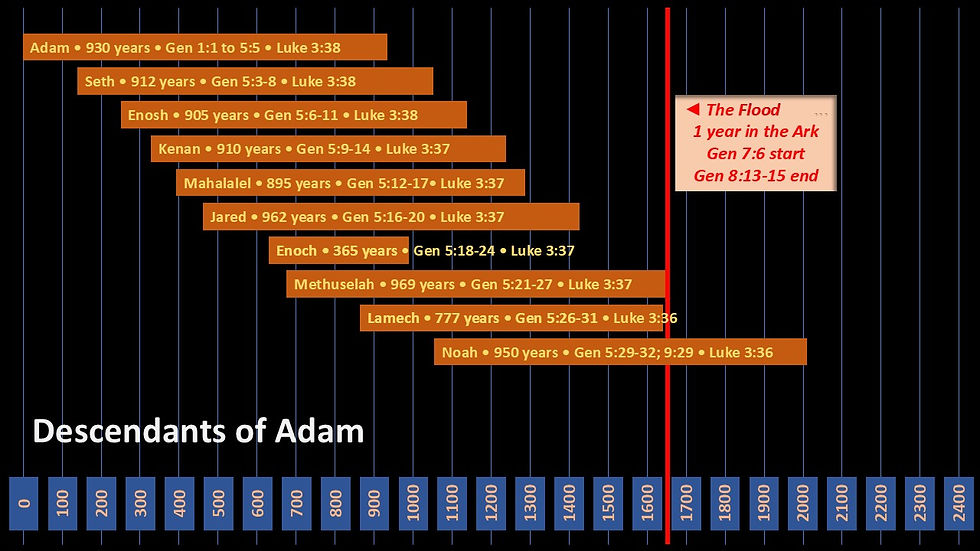
▲ click above to read the entire passage
► Adam → Gen 5:1-5 • 930 years
► Seth → Gen 5:3-8 • 912 years
► Enosh → Gen 5:6-11 • 905 years
► Kenan → Gen 5:9-14 • 910 years
► Mahalalel → Gen 5:12-17 • 895 years
► Jared → Gen 5:16-20 • 962 years
► Enoch → Gen 5:18-24 • 365 years
► Methuselah → Gen 5:21-27 • 969 years
► Lamech → Gen 5:26-31 • 777 years
► Noah → Gen 5:30-32; 9:29 • 950 years
Notice a few things…
1st • With the exception of Enoch, all of these guys lived A REALLY LONG TIME!
2nd • Enoch only lived 365 years but he was a special case.
→ Genesis 5:22-24 says that "Enoch walked God" twice, but it doesn't say that he died.
→ This phrase is only used one other time in the Scriptures, in reference to Noah, in Genesis 6:9.
→ The general speculation within the commentaries is that because of Enoch's exemplary life, God decided to bring him directly into His presence, not waiting for him to die.
3rd • Lamech made it almost to the flood, but his dad Methuselah made it to the flood.
→ Methuselah lived 782 years after Lamech was born, but Lamech only lived a total of 777 years – 5 years before Methuselah died.
4th • Did Methuselah die in the flood? Or just before it? There’s nothing in the text that indicates that he was spared.
5th • Noah was at least 500 years old when God told him to build the ark, and 600 years old when the flood started, and 601 years old when they got out of the ark.
6th • Noah’s 3 sons (Shem, Ham, Japheth) were born around the time that Noah was 500, before the flood. While Genesis 5:32 and Genesis 6:10 might give the impression that they were triplets, other verses show that they were born Shem first, then Japheth, and lastly, Ham. (compare Genesis 10:21 with Genesis 9:22-24).
7th • The flood would have happened 1656 years after Adam was created.
8th • If you do the math, Noah, his family, and all the animals were on the ark for a total of 376 days.
→ Compare Genesis 7:11 with Genesis 8:13-14.
Descendants of Shem (son of Noah)

▲ click above to read the entire passage
► Shem → Gen 5:29-32; 11:10-26 • 600 years
► Arpachshad → Gen 10:22; 11:10-13 • 438 years
► Shelah → Gen 10:24; 11:12-15 • 433 years
► Eber → Gen 10:24-25; 11:14-17 • 464 years
► Peleg → Gen 10:25; 11:16-19 • 239 years
► Reu → Gen 11:18-21 • 239 years
► Serug → Gen 11:30-23 • 230 years
► Nahor → Gen 11:22-25 • 148 years
► Terah → Gen 11:24-32 • 205 years
Notice a few things…
1st • It’s pretty obvious, for whatever reason, whether it was the protective water canopy that was now gone or some other factor, that post-flood people didn’t live as long as those born before the flood.
2nd • There were 9 pre-flood names listed, and there are 11 post-flood names listed, with 2, Noah and Shem, who were born before the flood, but didn't die until after it.
3rd • The 9 pre-flood guys covered a span of 1656 years, while the 11 post-flood guys only covered 660 years.
4th • In Genesis 11:26-27 it gives the impression, similarly to the list of Noah's sons in Genesis 5:32, that all of Terah's sons were born at the same time, but that is not accurate. We'll explore this in the next section.
→ From Genesis 11:28 & 31, we understand that all of Terah's sons were born in "Ur of the Chaldeans". This is a known location and is located in modern-day Iraq, south and west of the Euphrates River, about 160 miles inland from the Persian Gulf.
→ According to Genesis 11:31, from this location (Ur) Terah would leave to go to Haran, with Abram/Abraham and his wife Sarai, his grandson Lot (son of the deceased Haran) some 570 miles to the northwest, in what is now modern Turkey, just north of the Euphrates River.
→ It's not listed in this text that Abram's brother Nahor came with them to Haran, but if he didn't come on this trip, he must have come later, because in Genesis 24:15, after Abraham sends his servant to find a wife for Isaac, he finds "Rebekah who was born to Bethuel the son of Milcah, the wife of Abraham's brother Nahor". The location is now know as Nahor, so he must have become a person of prominence in order to have the town named after him.
Descendants of Abraham

Abram/Abraham
• Gen 11:26ff - birth
• Gen 25:7-10 - death
• 175 years
► It's a little more complicated to calculate the birthdate of Abraham, but we can back into it.
• Genesis 12:4 →
Starting here we understand that Abram/Abraham was 75 years old when he left Haran to move to Canaan.
• Acts 7:4 →
This verse confirms for us that Abram's leaving Haran happened after the death of his father, Terah.
• Genesis 11:32 →
From this verse we understand that Terah died when he was 205 years old.
• Genesis 11:26 →
Terah began fatherhood with the birth of his oldest son (either Haran or Nahor) when he was 70 years old.
► So if we are doing the math right, Terah would have been 130 years old when Abram was born, meaning that if Abram was the youngest son, that he was 60 years younger than his oldest brother.
→ Abraham was 86 years old when his son Ishmael (by Hagar) was born - Gen 16:16
→ He was 100 years old when his son Isaac (by Sarah) was born - Gen 21:5
→ Isaac marries Rebekah at 40 years of age; Abraham was 140 - Gen 25:20
→ Isaac's sons Jacob and Esau are born when Isaac is 60; Abraham was 160 - Gen 25:24-26
→ Abraham dies at 175 years of age - Gen 25:7
→ Jacob and Esau were 15 years old when Abraham died.
Isaac
• Gen 21:1-8; 35:27-29 • 180 years
→ Isaac was born when Abraham was 100 years old - Gen 21:5
→ Isaac marries Rebekah at 40 years of age; Abraham was 140 - Gen 25:20
→ Isaac's sons Jacob and Esau are born when Isaac is 60; Abraham was 160 - Gen 25:24-26
→ Jacob and Esau were 15 years old when Abraham died.
→ Isaac dies at 180 years old - Gen 35:28-29
Jacob/Israel
• Gen 25:19-26; 47:27-28; 49:28-33 • 147 years
→ There are no specific dates given for the births and/or deaths of any of Jacobs' kids.
→ We do know that the 1st 11 of Jacob's sons were born while he was serving his father-in-law Laban for 20 years.
→ The 12th son, Benjamin, was born after Jacob had reentered Canaan.
→ We can figure out the age of Joseph approximately by backing into it.
Joseph
• Gen 30:22-24; 50:22-26 • 110 years
→ Backing into the timeline of Joseph...
→ We do know that Joseph was 30 years old when he entered into service to Pharoah - Gen 41:46. Jacob would have been 121 years old.
→ We can calculate that Jacob moved to Egypt after the 7 years of plenty, and then 2 years of famine (verse 6), making Joseph 39 years old - Gen 45:4-15.
→ Jacob was 130 years old when he entered Egypt and was presented to Pharoah - Gen 47:7-12.
→ Jacob died when he was 147 - Gen 47:28. Joseph would have been 56 years old.
→ Based on these facts we understand these other details...
♦ Joseph would have been about 28 when he was put into prison by Potiphar, after being accused of rape by Potiphar's wife - Gen 41:1. Jacob would have been 119 years old.
♦ Joseph was sold into slavery when he was 17 years old - Gen 37:2, 18-28. Jacob would have been 108 years old.
♦ Joseph would have served in Potiphar's house for 11 years.
♦ Which means that Jacob was 91 years old when Joseph was born.
♦ Which also means that Jacob was somewhere in the range of 71-74 when he left Canaan to find a wife.
♦ When Joseph died it would have been 2,370 years since the creation of Adam.
The timelines of Genesis
►Below is a chart that shows the line of Christ from Adam to Jacob/Israel.
→ There are 2 names in the list that are NOT in the line of Christ, but I included them just for the sake of reference.
• Ishmael, Abram's son from Hagar, is included, but it is only to remind us of Abram and Sarai's feeble attempt to help God fulfill His promise of a son that was to be born for them. Obviously, this didn't work the way they planned, and then 13 years later God fulfilled His promise with the birth of Isaac.
• Joseph, Jacob's 11th son, the 1st of only 2 sons from his beloved wife Rachel, is included because of all of Jacob's sons, this is the only one that has clear enough dates for us to actually calculate when he was born and died. This also rounds out the book of Genesis, at least from a timetable viewpoint, allowing us to understand that from the creation of Adam it was 2,370 years until the death of Joseph.
♦ I also want to add a side note about Joseph, in that even though he is not in the line of Christ, he does actually give us a picture of Christ, as he saved his people from certain death because of the famine of the time. By saving his family (about 70 or 75 people), the number increased in the 400 years between Genesis and Exodus to somewhere over 1 million people.

The line of Christ in the Gospel of Matthew (from Judah to Jesus)

► All of the names in the 1st column are found in both Matthew's and Luke's Gospels. The lists deviate after David.
► Matthew's Gospel tracks the line of Jesus through David's son Solomon.
► Most likely this is the lineage of Joseph, Jesus' step-father.
► All the angelic appearances are to Joseph.
► There are 5 women listed in this genealogy, and all of them have a bad reputation, 3 for fact, 1 for national origin, and 1 for the appearance of wrongdoing.
→ The 3 for fact deserve their bad reputations...
• Tamar pretended to be a prostitute in order to have her father-in-law Judah impregnate her in order to be able to produce a child for her late husband, Judah's son Er. You can read the about the entire messy affair in Genesis 38:1-30.
• Rahab was the harlot that hid the Jewish spies in Jericho. She would not only be saved from destruction because of her actions, but would also become the wife of an Israelite, Salmon. Her son would be Boaz. You can read all about this in Joshua 2:1-24 and Joshua 6:1-27.
• Bathsheba (read 2 Samuel 11 & 12 to see this entire story) was a woman married to a soldier named Uriah. While Uriah was away at war, David the King watched her bathing on her roof-top and ended up committing adultery with her and producing a child out of wedlock. In his attempts to cover his crime, he ended up orchestrating the death of her husband. The child of that union would die. Nathan the prophet would confront David about this, and David repented. He married Bathsheba, and their next child was Solomon, who would become king after David.
♦ The unique thing about this listing, is that in the original Greek texts, Bathsheba's name does not appear. Most modern translations show her name, which I believe is a mistake. In the Greek she is only referred to as "her of Uriah", and in my mind it's written that way to show that the only person with any honor in this mess was Uriah.
→ Ruth was a woman who had a bad reputation for having a different national origin. She was one of two Moabite women who had married Israelite men, brothers who were sons of Elimelech and Naomi, who later died, along with their father. One of the Moabite women returned to Moab, but Ruth chose to stay and follow Naomi saying "where you go, I will go, and where you lodge, I will lodge. Your people shall be my people, and your God, my God." (Ruth 1:16). The entire book of Ruth is about her. She would marry Rahab's son Boaz, and their son Obed was the grandfather of King David.
→ Mary was by default the one with the bad reputation for being pregnant out-of-wedlock. While engaged/betrothed to Joseph, she is found to be pregnant, and even though the angels told both Mary and Joseph that this was a GOD thing, you can only imagine the side-ways-glances that family would have to endure for the rest of their lives. Even during Jesus ministry, some antagonistic Jews, when being confronted by Jesus about Abraham, stated in John 8:41, "we were not born of fornication;...", the implication that Jesus was.
Genesis
Judah (with Tamar)
Perez
Hezron
Exodus, Numbers, Ruth, Samuel, 1 Kings
Ram
Amminadab
Nahshon
Salmon (with Rahab)
Boaz (with Ruth)
Obed
Jesse
David (with her of Uriah)
Kings, Chronicles, Esther, Jeremiah
Solomon
Rehoboam
Abijah
Asa
Jehoshaphat
Joram
Uzziah
Jotham
Ahaz
Hezekiah
Manasseh
Amon
Josiah
Jeconiah
Chronicles, Ezra, Nehemiah, Haggai, Zechariah
Shealtiel
Zerubbabel
The 400 “silent” years
Abihud
Eliakim
Azor
Zadok
Achim
Eliud
Eleazar
Matthan
Jacob
Joseph (husband of Mary)
Jesus
The line of Christ in the Gospel of Luke (from Judah to Jesus)

► All of the names in the 1st column are found in both Matthew's and Luke's Gospels. The lists deviate after David.
► Luke's Gospel tracks the line of Jesus through David's son Nathan.
► Most likely this is the lineage of Mary, Jesus' mom.
► All the angelic appearances are to Mary.
► There are two names on the list that are the same names, in the same order, as the list in Matthew, but I believe this to be a coincidence. Shealtiel and Zerubbabel are listed in both genealogies, in the same order, but the names of the predecessor and subsequent children are all different.
Genesis
Judah (with Tamar)
Perez
Hezron
Exodus, Numbers, Ruth, Samuel, 1 Kings
Ram
Amminadab
Nahshon
Salmon (with Rahab)
Boaz (with Ruth)
Obed
Jesse
David (with her of Uriah)
Kings, Chronicles, Esther, Jeremiah, Ezra, Nehemiah, Haggai, Zechariah, and the 400 “silent” years
Nathan
Mattatha
Menna
Melea
Eliakim
Jonam
Joseph
Judah
Simeon
Levi
Matthat
Jorim
Eliezer
Joshua
Er
Elmadam
Cosam
Addi
Melchi
Neari
Shealtiel
Zerubbabel
Rhesa
Joanan
Joda
Josech
Semein
Mattathias
Maath
Naggai
Hesli
Nahum
Amos
Mattathias
Joseph
Jannai
Melchi
Levi
Matthat
Eli (Mary’s father)
Joseph (Mary’s husband)
Jesus
So What?
► It's easy to overlook all those long lists of names, most of which are hard (maybe impossible) to pronounce.
► On and on they go, often repeating the same cadence over and over again.
► Born, begat, died. Born, begat, died. Etc., etc., etc.
► BUT, when investigated carefully, we can find so many wonderful things, like...
→ That some of the old-timers (from Adam to Eber), would all live long enough to not only see their grandchildren, but in some cases, like that of Noah, to see their great, great, great, great, great, great, great, grandkids.
→ There is a direct physical human connection, actually two of them, carefully recorded in the Scriptures, that give proof of continuity for Jesus, all the way back to Adam.
→ The genealogies also remind us that women are just as much a part of the plan as are the men, and in some cases, are actually the key component in their respective relationships.
→ There's room for "screw-ups" like me in God's plan. If Abraham, and Jacob, and even later David, can all fail so horribly, and still be of use to God, then maybe there's hope for me also.
→ One would expect if these lists were made up, the lists would be a queue of super-heroes, rather than a list of super-zeros. Why would you make a work of fiction, and fill it with people who can't do the job.
► So again, these lists are important to me, because they connect me, both from a physical heritage, but more importantly through a spiritual connection to God through Jesus.
“Scripture quotations taken from the (NASB®) New American Standard Bible®, Copyright © 1960, 1971, 1977, 1995
by The Lockman Foundation. Used by permission. All rights reserved. lockman.org”
All linked verses are from the YouVersion at www.Bible.com


Comments